
Hidden Cost of Cheap Raisins for Bulk Buyers
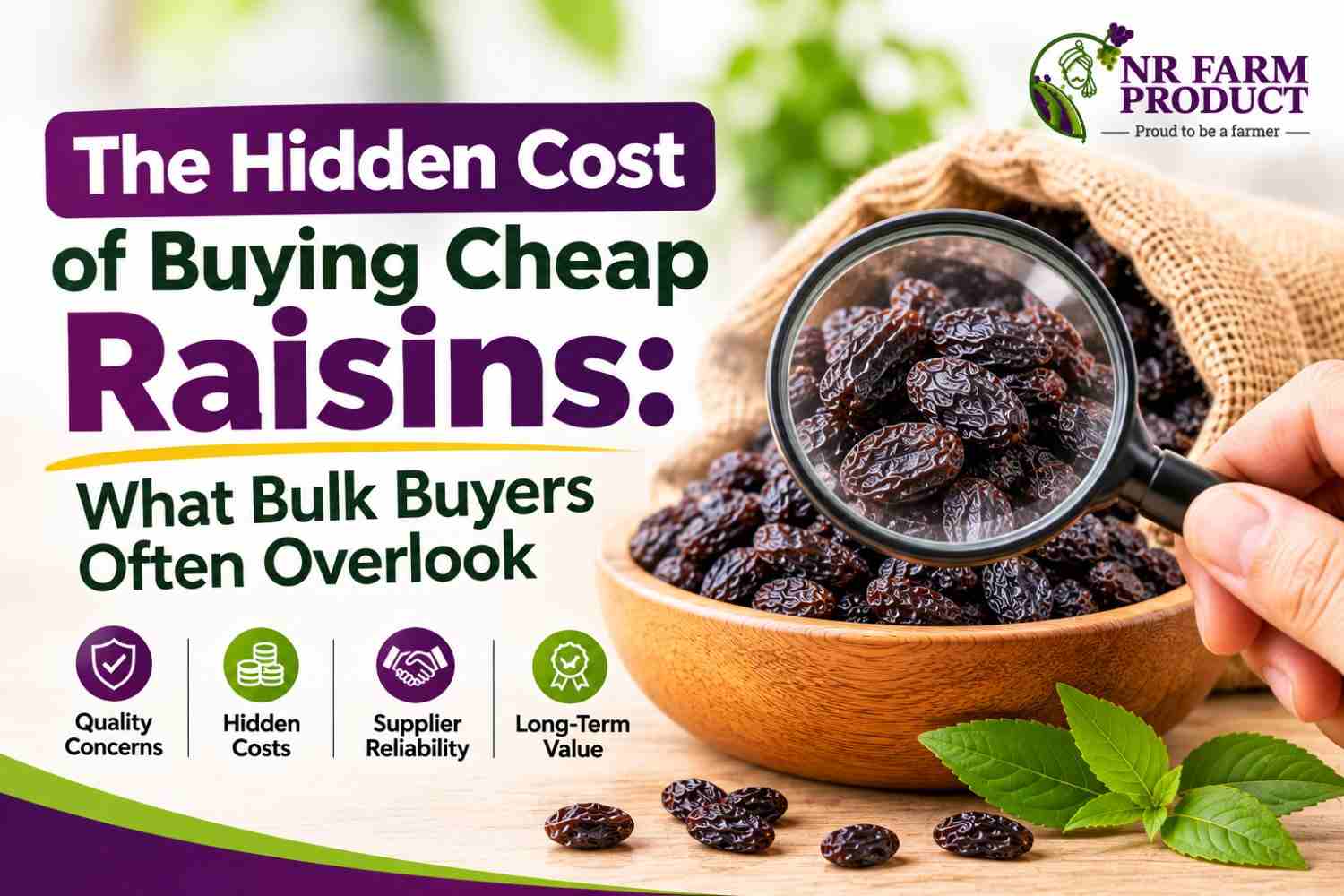
Every procurement manager loves a good deal. When one supplier quotes ₹80 per kg, and another quotes ₹110, the cheaper option feels like the obvious choice. But bulk raisin buyers across the food manufacturing, bakery, and confectionery industries are learning a hard lesson: the hidden cost of buying cheap raisins often exceeds the money saved upfront.
The real price of cheap raisins does not show on the invoice. It shows up later in production delays, customs rejections, customer complaints, and emergency reorders. By then, the savings are long gone.
This blog breaks down exactly what bulk buyers overlook when choosing raisins on price alone, what those mistakes actually cost, and what to look for instead.
Why Do Bulk Buyers Choose Cheap Raisins?
Price pressure drives most cheap raisin decisions. Procurement teams face quarterly cost-cutting targets. When raisins look similar on paper, the cheaper supplier feels like the logical choice.
The bigger problem is a common assumption: that all raisins perform the same way in production. They do not. Most buyers only discover this after the shipment arrives, when the order is paid, and the production schedule is locked.
What drives cheap raisin decisions?
- Budget pressure to reduce ingredient costs
- No sample testing before bulk orders
- Assuming price difference reflects margin, not quality
- Comparing invoice cost instead of total production cost
What Makes a Raisin “Cheap”?
Low price means something in the process has been cut. Understanding what gets cut helps buyers spot risk early.
Common reasons raisins are priced below market:
- Mixed or lower grades: inconsistent size, color, and broken pieces
- Poor drying: uneven moisture causes storage and production problems
- Minimal sorting: stems, stones, and foreign material reach your line
- No lab testing: no proof of aflatoxin, pesticide, or microbial safety
- Missing certifications: no FSSAI or APEDA compliance
The Hidden Costs Bulk Buyers Overlook
This is where cheap raisins show their real price.
1. Production Downtime
Unsorted raisins require manual cleaning before use. That costs labor hours, slows output, and pushes delivery deadlines.
2. High Waste & Low Yield
If 15–20% of your order is unusable, you pay full price for stock you cannot sell. The low price per kg stops making sense fast.
3. Customs & Import Rejection
Raisins failing aflatoxin, pesticide, or microbial tests get rejected or destroyed at customs. You lose the product, freight cost, and time, then pay premium prices for emergency stock.
4. Finished Product Complaints
Inconsistent raisins produce inconsistent products. Customers notice size, texture, and taste differences. One complaint batch can erase a full year of sourcing savings.
5. Compliance Failures
Without proper lab reports and certifications from your supplier, your own HACCP compliance becomes hard to prove. This risks audit failures and lost retail contracts.
6. Emergency Reorders
Rush replacement orders cost more. Express freight costs significantly more. The original saving disappears completely.
The Real Cost: A Simple Calculation
Scenario: A bakery orders 1,000 kg of raisins per month.
|
|
|
|
|
|
|
|
|
|
|
|
|
|
|
|
|
|
|
|
|
|
|
|
|
|
|
|
|
|
|
|
The gap is only ₹7,500 without factoring in customs rejection or emergency reorders. In months with quality failures, cheap raisins cost more. Price per kg is not the same as cost per kg. Understand the real bulk raisin price in India before buying.
What to Check Before Your Next Bulk Order
Before buying the raisins, buyers should check the key quality parameters:
- Request a sample: test size, color, smell, and cleanliness
- Ask for lab reports: moisture (15–18%), aflatoxin, pesticide, microbial
- Verify certifications: FSSAI licence and APEDA registration
- Ask about sorting: AI-assisted sorting delivers more consistent batches
- Check packaging: food-grade, moisture-proof only
- Compare total cost: not just price per kg
How NR Farm Product Helps Bulk Buyers
NR Farm Product is based in Nashik, Maharashtra, India’s key raisin-growing region. The business serves B2B buyers, including food manufacturers, wholesalers, processors, and private-label brands.
What NR Farm offers:
- AI-assisted grading and sorting for consistent batch quality
- Multiple varieties: Sonaka, Thomson, Black, Golden and Green Raisins
- Transparent quality process with clear product documentation
- Direct B2B supply with no retail distribution
We do not compete on the lowest price. It focuses on consistency, reducing waste, and removing the hidden costs of cheap raisins that cheaper suppliers quietly introduce.
Conclusion
Cheap raisins rarely save money in the long run. Wasted stock, production delays, quality complaints, and customs failures cost far more than the original price difference.
Bulk buyers who track total sourcing cost, not just price per kg, often see this. Quality raisins deliver better value over time.
Before your next order, request a sample, check lab reports, and verify certifications. Visit our website to review our raisin product range or contact us to discuss your sourcing requirements directly.
FAQs
1. Why are cheap raisins more expensive long-term?
Hidden costs, waste, sorting labor, delays, and complaints add up fast. Total real cost almost always exceeds the original savings.
2. What are common quality problems with cheap raisins?
Inconsistent size, uneven moisture, foreign material, and missing lab reports. Aflatoxin and pesticide failures at customs are also serious risks.
3. How do I check raisin quality before bulk ordering?
Request a sample first. Ask for lab reports covering aflatoxin, pesticide residue, and microbial safety before confirming any order.
4. What certifications should a raisin supplier have?
FSSAI licensing and APEDA registration are essential for Indian suppliers. Always request actual certificate copies, not verbal confirmation.
5. How does poor raisin quality affect manufacturing?
It slows production, increases waste, creates product inconsistency, and complicates food safety compliance, risking retail contracts and audits.